
Dog walking is still wildly misunderstood.
Some people see it as “just taking dogs out for a stroll”… when in reality it’s a professional service, a safety-critical role and (when it’s done well) one of the most impactful jobs in a dog’s life.
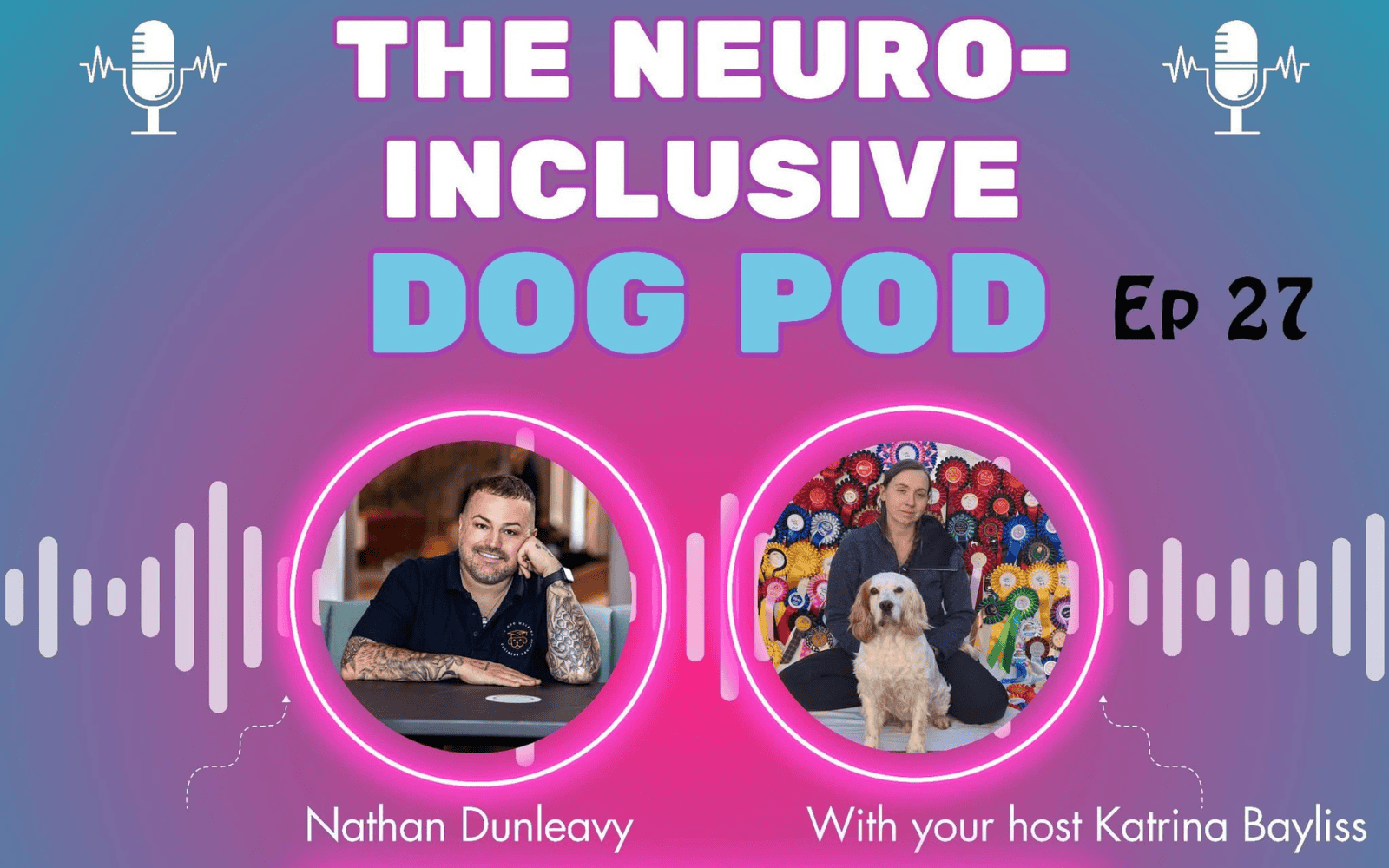
Recently I was invited onto Katrina’s podcast, The Neuro Inclusive Dog Pod (hosted by The Neurodivergent Dog Coach) to chat about dog walking, neurodiversity, business boundaries and why so many pet pros burn out trying to run their business like someone else.
This blog is a recap of that conversation – with my biggest takeaways and a few practical pointers if you’re considering dog walking (or you’re already doing it and secretly wondering if you’re doing too much).
Who I am (and why I care so much about dog walkers)
I’m Nathan Dunleavy – based in Southampton with my husband Mark and our seven dogs (yes… seven. I know).
My local business is Nathan’s Paw Trails Ltd and we’ve been running for nearly 8 years with a small team. I’m still out walking dogs four days a week, because honestly… it’s the part of the job that keeps me grounded.
Alongside that, I run The Dog Walking Business Mentor because dog walking is still one of the most under-supported, underrepresented professions in the pet industry. We’ve got training communities, grooming communities, behaviour communities… but dog walkers? Often left to figure it out alone in an unregulated industry where anyone can “just start”.
That’s exactly why I mentor dog walkers – whether you’re:
- starting from scratch,
- trying to build a sustainable diary,
- taking on your first team member,
- or expanding into other services like pet sitting or training walks.
Why dog walking can be a brilliant fit for neurodivergent people
Katrina’s audience includes a lot of neurodivergent listeners and one of the big topics we explored was: why pet care can work so well for neurodivergent brains.
A few reasons really stood out:
1) Nature is the original therapist
Dog walking gets you outside, moving and away from a desk. It’s not a magic fix (nothing is), but it’s hard to ignore the impact of fresh air, daylight and rhythm.
2) Dogs are easier than humans (and yes, I said what I said)
For many neurodivergent people, human communication can feel draining or confusing. Dogs don’t do small talk. They don’t judge. They’re honest, predictable in their own way and they communicate clearly – once you learn the language.
3) You can design the job around your needs
Dog walking isn’t one-size-fits-all. You can shape it around:
- your energy levels,
- your preferred communication style (WhatsApp, email, booking links),
- your capacity for social interaction,
- your need for routine (or flexibility).
And that matters.
“Where do I even start?” The real basics of becoming a dog walker
This came up in the episode and it’s the million-pound question.
Because dog walking is unregulated, there’s no official “you must do X, Y, Z”… which is exactly why so many people start without the foundations.
If you want my bare minimum checklist, it’s this:
✅ Hands-on experience
Owning a dog isn’t the same as working with dogs. Volunteer at rescues, shadow experienced professionals, learn in real environments.
✅ DBS check
You’re entering people’s homes. Get it done – even if most clients never ask to see it.
✅ Specialist insurance
You want proper cover that includes (as needed):
- public liability,
- professional indemnity,
- employers’ liability (if you have staff),
- loss of keys,
- lost dog cover, etc.
✅ Canine first aid training (and refresh it)
I personally refresh annually. Not because I’m dramatic but because you don’t want to be trying to remember first aid from years ago in a real emergency.
✅ A proper first aid kit
- one you carry on you,
- and a more robust one in your vehicle.
✅ Vehicle insurance for business use
This catches people out. Make sure you’re properly covered.
✅ Canine body language knowledge
You don’t need a full behaviour qualification to start but you do need to understand:
- stress signals,
- escalation,
- distance-increasing behaviours,
- what “waggy tail” actually means (spoiler: not always “happy”).
Solo walks vs group walks (and why “more dogs = more money” isn’t always true)
We talked about how some dog walkers group dogs together with very limited knowledge and just hope for the best.
That’s not a business model. That’s a roulette wheel.
Here’s my view:
Solo walks can be a powerful foundation
I started with solo walks and it gave me such a strong base because many solo dogs are solo for a reason (reactivity, sensitivity, confidence issues). It teaches you to observe properly and manage real-world situations safely.
Group walks require skill, not just confidence
Matching dogs safely isn’t about vibes. It’s about:
- temperament,
- arousal levels,
- play styles,
- triggers,
- recall reliability,
- your handling ability,
- and your ability to read the whole group, constantly.
Also worth knowing: many insurers only cover up to a certain number of dogs (often 6) and some councils have their own rules/licensing expectations – so always check locally.
The hidden reality: dog walking is physically and mentally demanding
This bit mattered, because so many people start dog walking thinking it’s “easy money”.
In reality, it’s:
- physically intense (walking, lifting dogs, handling multiple leads),
- logistically heavy (pick-ups, drop-offs, driving, traffic),
- weather dependent (and the dogs still need walking in sideways rain),
- emotionally demanding (because dogs are family members and the responsibility is real).
If you’re a “fair weather” person who only wants to work when it’s sunny… dog walking will humble you very quickly.
Business wellbeing: boundaries are not walls – they’re bumpers
This was one of my favourite parts of the conversation.
Pet pros often burn out because we’re caring people and caring people can end up being permanently “on”.
Some boundary basics I recommend (especially for dog walkers):
Separate business and personal contact
A separate business phone can be a game changer because it allows you to truly switch off.
Use WhatsApp Business tools
Set business hours, autoreplies, holiday messages – even a simple “Thanks for your message, I’ll reply tomorrow” protects your nervous system and reassures the client.
Don’t break your own boundaries
If you say “I don’t reply after 6pm” but reply at 8pm… clients learn your boundaries are negotiable.
Curate your social media feed
Your feed should support you, not drain you. Unfollow, mute, leave groups that don’t align. Find your people.
And my favourite analogy:
Boundaries are like the bumpers in bowling.
They’re not there to block you in – they’re there to protect you from going off track.
Ethics, marketing and the “5K month” pressure
We also spoke about the harm that can come from certain styles of business coaching – especially the high-pressure “5K months” messaging.
If someone’s chasing a target, that’s their choice but my concern is what happens when they hit £4,999 and feel like they’ve failed.
That mindset doesn’t create sustainable businesses. It creates anxious business owners.
You can grow without burning out, without cold DMing strangers and without pretending to be someone you’re not.
Especially in pet care, where your reputation, safety standards and integrity matter more than flashy tactics.
The unexpected joys of dog walking
To finish on the good stuff…
Dog walking can be genuinely joyful.
- Dogs are excited to see you.
- You build real relationships with them.
- You’re outside every day.
- You create a diary that can work around your life.
- You become part of a wider network of pet professionals.
- You get that quiet, satisfying feeling of: “I’m doing something that matters.”
And honestly? Watching a dog having the best time in the mud, completely unbothered by British weather… is weirdly therapeutic.
Want support building your dog walking business (without the overwhelm)?
If you’re starting up – or you’re already running a dog walking business but want to tighten things up, feel more confident, and build something sustainable that’s exactly what I help with inside The Dog Walking Business Mentor.
If you’d like a simple place to begin, grab my free guide and plan:
➡️ 5 Steps to a Successful Dog Walking Business
And if you’d like to chat about mentoring support, pop me a message and we’ll figure out what would help most.
Episode link:
If you’d like to listen to the full conversation with Katrina, here’s the episode:
Katrina’s links:
Neuro-Inclusive Dog Hub UK – (Free Facebook Group)
Dogs And Divergent Minds – (Website)
