
What if you didn’t need to do more, achieve more or have everything figured out before giving yourself permission to slow down?
As pet professionals, we spend so much of our time looking after others.
The dogs in our care. The people who love them. Our clients. Our businesses.
And somewhere amongst all of that, we can forget about the person doing the looking after.
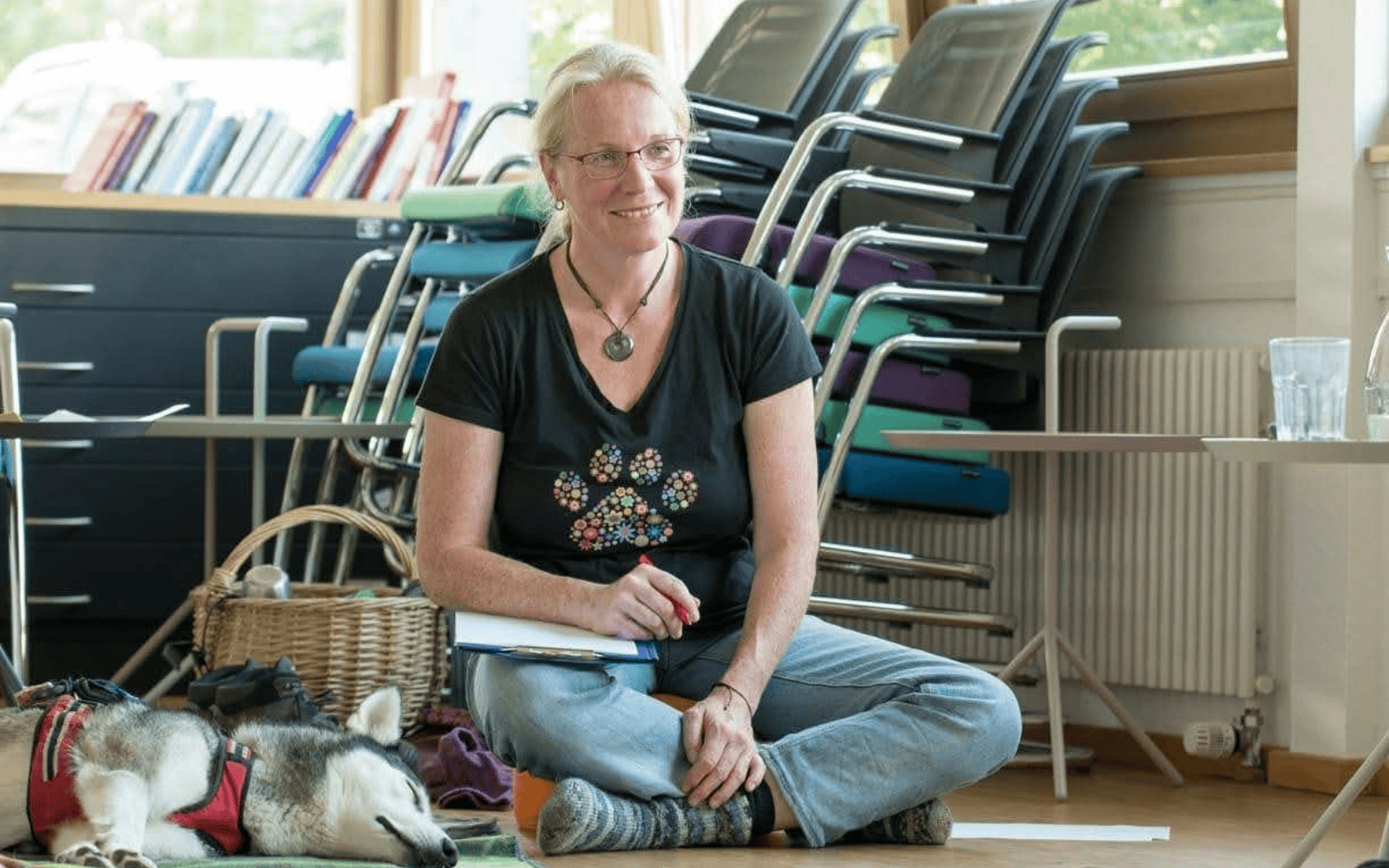
In the latest episode of The Pet Business Wellbeing Podcast, I was joined by my wonderful friend and colleague Biggi Junge, a dog trainer, Behaviour Adjustment Training instructor, meditation teacher and founder of Pawprints & Presence, based in Germany.
We explored her personal and professional journey, the dog who changed everything, burnout, grief, mindfulness and what it means to give ourselves permission to do things differently.
And, for the first time on the podcast, we did something a little different.
Biggi guided us through a gentle mindfulness exercise centred around permission.
I’ll come back to that, because it was a particularly meaningful moment for me.
A Long and Winding Road Into the Dog Industry
Like many of the guests I’ve welcomed onto the podcast, Biggi didn’t begin her working life in the dog industry.
She originally trained as a nurse before studying sports science and English at university. She later specialised in sports rehabilitation and orthopaedics.
Looking back, she recognises that every stage of her career helped shape the way she works with people and dogs today.
Nursing taught her to listen, communicate and notice what people might be expressing beyond their words.
Working in sports science and rehabilitation taught her to meet people where they are and adapt information so they can understand and use it.
But her working life also came with a pattern that I suspect many pet business owners will recognise.
Working.
Working.
And then working some more.
Eventually, Biggi experienced significant burnout and needed an extended period away from work.
During that time, she began asking herself what she genuinely wanted from life.
What brought her happiness?
What helped her feel more like herself?
And what had she always wanted to make space for?
Right at the top of her list were dogs.
First Came Nana. Then Came Charlie.
Biggi hadn’t grown up with dogs, although she had always loved them.
Once she had the time and opportunity, she welcomed Nana, a German Shepherd, into her life.
Nana was a wonderful first dog who made things feel relatively straightforward.
And then came Charlie.
Charlie was a Spanish sighthound mix who had experienced a difficult start in life before arriving with Biggi.
He was easily excited, reactive towards other dogs and vehicles, struggled with being left alone and had a particularly strong predatory instinct.
In other words, he was quite a character!
Biggi tried to find ways to help him.
She sought advice.
She studied dog training.
She tried different approaches.
But Charlie didn’t become the dog she thought she was supposed to have.
And because she was now training to become a dog professional herself, that brought another layer of expectation.
Surely, if you’re a dog trainer, you should be able to help your own dog?
It’s a thought I think many of us have had at one time or another.
We can understand so much about behaviour, learning and the individual needs of dogs, yet still feel enormous pressure when our own dog struggles.
For Biggi, a turning point eventually came during a walk in the Bavarian Alps.
When Trying to Change Charlie Wasn’t Working
Biggi described standing on a forest path after another difficult encounter with a dog.
She was frustrated, exhausted and overwhelmed.
She cried and let out everything she had been holding in.
And something began to shift.
She couldn’t control which dogs appeared on their walks.
She couldn’t control every situation the world presented.
And despite all the work she had done, she couldn’t turn Charlie into a completely different dog.
But there was something she could begin exploring.
Her own expectations, emotions and responses.
What did she believe a dog should be like?
What did she expect of Charlie?
And what did she expect of herself as his guardian and as a dog trainer?
Biggi had already been practising mindfulness, but until that point, she hadn’t fully connected it with her experiences of living with Charlie.
Over time, she began bringing mindfulness, breathing, grounding and self-compassion into their everyday life together.
And rather than continually focusing on changing Charlie, she began learning to accept him for who he was.
That didn’t mean ignoring his needs or abandoning the practical management required to keep everyone safe.
It meant shifting the goal.
The aim was no longer to create the perfect dog.
It was to find a way for Charlie and Biggi to live together, understand one another and enjoy the relationship they actually had.
Charlie continued to react to other dogs throughout his life.
But Biggi’s experience of living with him changed.
I think there’s a really important message in that.
Progress doesn’t always mean that every challenging behaviour disappears. Sometimes progress is a change in how we understand, support and respond to the dog in front of us.
What Charlie Taught Biggi About Self-Compassion
Something that stood out to me during our conversation was Biggi’s honesty about making mistakes.
Because we all do.
Even with the best intentions, there will be times when we don’t respond in the way we wish we had.
We might become frustrated.
We might misjudge a situation.
We might look back and think we could have handled something differently.
And when you work professionally with dogs, it can be particularly easy to hold yourself to an impossible standard.
But Charlie helped Biggi develop a different relationship with those moments.
She learned to pause.
To notice her emotional response.
To be more compassionate towards herself.
And to recognise that being imperfect doesn’t mean you have failed your dog.
I think that lesson reaches far beyond dog training.
How often do we expect ourselves to get everything right in business?
Every client conversation.
Every decision.
Every social media post.
Every boundary.
Every single day.
That’s an exhausting standard to try to maintain.
Grief, Support and Finding a New Direction
Charlie died in 2024.
Biggi spoke very openly about the profound grief that followed and how difficult life became after losing him.
Eventually, she recognised that she needed additional support and returned to therapy.
I’m grateful to Biggi for being willing to talk about that part of her experience.
Pet loss can have an enormous impact, particularly when a dog has played such a significant role in our personal life and professional identity.
There isn’t a timetable for grief and we don’t have to navigate it entirely on our own.
As Biggi gradually began considering her next steps, she also reconnected with a professional support community and received encouragement to develop her business for an international, English-speaking audience.
That became another important turning point.
Her love of the English language, her previous professional experiences, her work with dogs and everything Charlie had taught her began coming together in a new way.
And Pawprints & Presence began to take shape.
What Does Mindfulness Have to Do With Dog Training?
Biggi’s work sits at the intersection of dog behaviour, training, mindfulness and the human experience.
And during our conversation, she offered a beautifully simple way of looking at mindfulness:
Being present with what is happening, as it is, without immediately judging it or trying to make it different.
That sounds simple.
But how often are we actually present?
We’re thinking about the next appointment.
Replying to messages.
Replaying something that happened yesterday.
Wondering what we need to do tomorrow.
Scrolling through social media and comparing our businesses with somebody else’s.
And sometimes we can spend so much time thinking about what needs to happen next that we miss what’s happening right in front of us.
Biggi spoke about the quiet pleasure of simply sitting alongside her dog Lucia and being present with her.
No task to complete.
No result to achieve.
Just spending time together.
As I often say, perhaps we could all learn to be more dog.
You Have Permission to Pause
Around halfway through the podcast, Biggi invited us into a guided mindfulness exercise.
The theme was permission.
Permission to slow down.
Permission to take a breath before moving on to the next thing.
Permission to do things your own way.
Permission not to compare yourself with everybody else.
Permission to rest, make mistakes, be a beginner or change direction.
And permission to allow your business to follow a path that works for you, rather than somebody else’s timeline.
I found the exercise unexpectedly emotional.
I had been feeling quite emotional that day anyway, but something about giving myself those few minutes to pause and listen really stayed with me.
It reminded me how much pressure we can carry without necessarily noticing it.
The pressure to keep showing up.
To be visible.
To grow.
To do more.
To keep up with what everybody else appears to be achieving.
And sometimes, underneath all of that, we simply need a little space.
Your business doesn’t have to look like somebody else’s business.
You are allowed to build it around your own values, circumstances and capacity.
You are allowed to change your mind.
And you don’t have to prove your worth by being the busiest person in the room.
A little invitation for you
Before you rush off to the next thing, perhaps ask yourself:
What permission would I like to give myself today?
It might be permission to finish work on time.
To leave that non-urgent message until tomorrow.
To take a day off.
To say no.
To enjoy the work you’ve already done rather than immediately looking for the next thing to achieve.
Or perhaps it’s simply permission to take one breath.
You don’t need to have a big answer.
And you don’t need to turn this into another task on your to-do list.
Sometimes One Breath Is Enough
Towards the end of our conversation, I asked Biggi what permission she would most want to give somebody who was carrying a lot of expectation around their dog, business, grief or even who they thought they should be.
Her answer was wonderfully simple:
Give yourself permission to pause.
You don’t always have to respond immediately.
You don’t always have to jump straight into action.
Sometimes taking one breath gives you a little space to notice what you’re feeling before deciding what to do next.
Of course, a pause won’t solve every difficult situation or remove every pressure we face.
But it can give us an opportunity to respond a little more thoughtfully, rather than simply reacting.
And for those of us running businesses, working with animals and managing the needs of so many different people, that little bit of space can be incredibly valuable.
Because wellbeing doesn’t always have to begin with a major life change.
Sometimes it begins by allowing ourselves to pause.
Listen to the Full Episode and Experience Biggi’s Guided Exercise
I would really encourage you to listen to my full conversation with Biggi.
Her personal journey is incredibly moving and the guided mindfulness exercise offers a lovely opportunity to experience a little of how she works.
You don’t need any experience of meditation or mindfulness to take part.
Just find a safe, comfortable setting where you can give yourself a few minutes and take whatever feels useful to you.
If you’re driving, cycling or handling a dog in a situation that needs your full attention, save the guided section for another time.
🎧 Listen to or watch the full episode here
Find Out More About Biggi Junge
You can explore Biggi’s work and connect with her through Pawprints & Presence
Biggi will also be joining us as a guest speaker inside The Pet Business Wellbeing Circle+ in October, where we’ll explore the theme What’s Mindfulness Got to Do with It?
I’m really looking forward to welcoming her into the membership and continuing this conversation.
The Pet Business Wellbeing Circle+ Is Open Again! 🌿
If Biggi’s story and guided exercise have left you thinking that you’d like to give yourself a little more space, support and permission to do things differently in your own business, I’d love to welcome you into The Pet Business Wellbeing Circle+.
Circle+ is my group mentoring and wellbeing membership for pet professionals who want to build sustainable, fulfilling businesses without feeling they have to do everything alone.
Inside, you’ll find two live sessions each month, guest experts, practical resources, session replays and PDF summaries, Ask Nathan support and a private community away from Facebook.
And I’m particularly excited that Biggi will be joining us as a guest speaker in October for her session, What’s Mindfulness Got to Do with It?
There’s no expectation to attend everything, keep up with every resource or make huge changes overnight.
Come as you are. Take what you need. And make use of the support in a way that works for you.
Circle+ is now open again, but only until midnight on Sunday 27th September.
If you’ve been thinking about giving yourself and your business a little more support, I’d love to have you join us. 💙
👉 Find out more and join Circle+
Wellbeing isn’t a luxury. It’s part of the business plan.
