
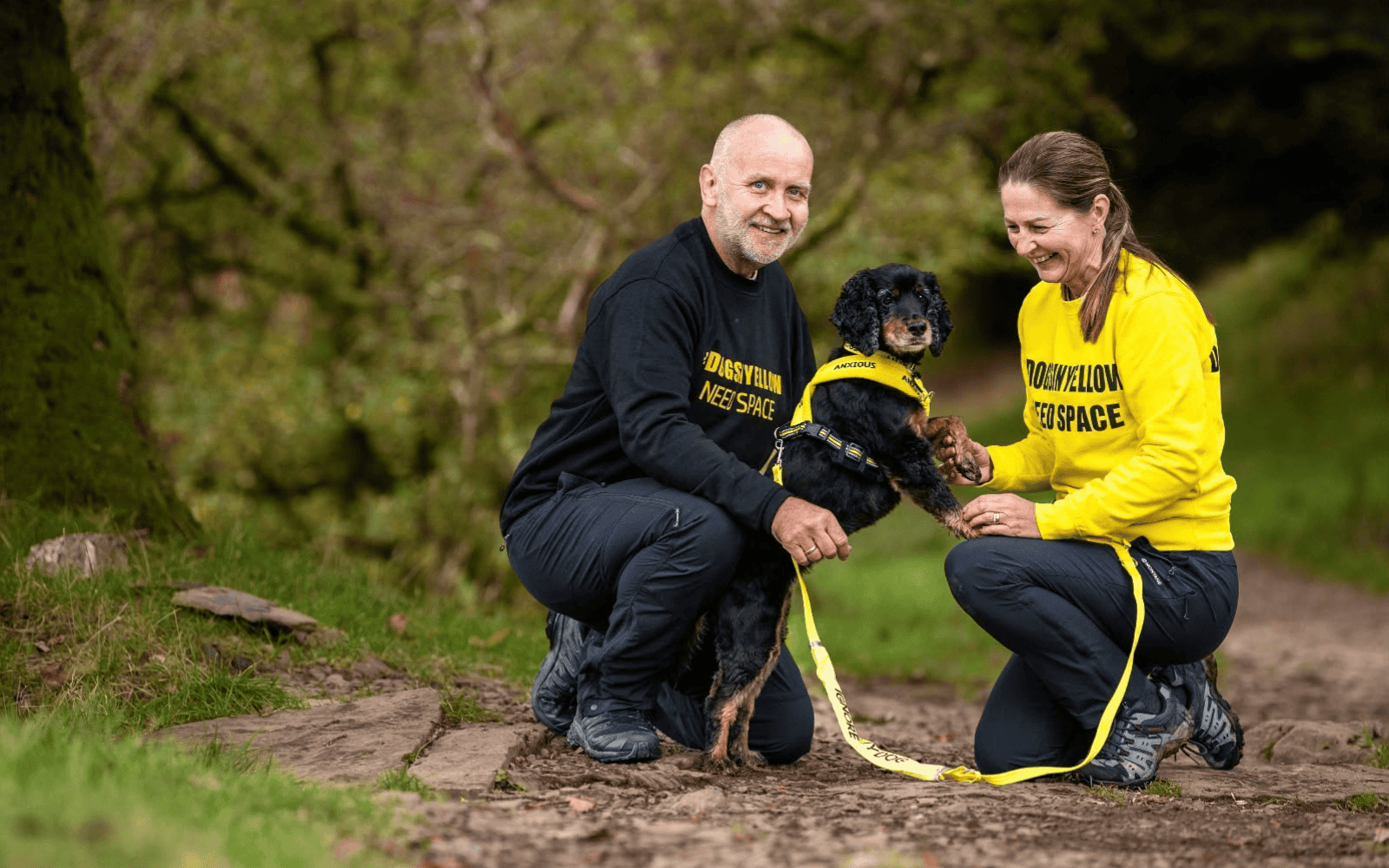
There are moments in life that divide everything into before and after.
For my latest guest on The Pet Business Wellbeing Podcast, that moment happened on 16th June 2019.
Matt Jones, husband of My Anxious Dog founder Sarah Jones, went out on what should have been an ordinary group cycle ride.
Instead, a devastating collision changed his life.
But when I invited Matt onto the podcast, I didn’t want to begin with the accident.
Because before Matt was the man who survived a catastrophic cycling accident, before he lost an arm and before My Anxious Dog became such an important part of his life, there was a whole person there.
And that’s really what this conversation became about.
The person behind what happened.
Who Was Matt Before Everything Changed?
Before 2019, Matt and Sarah were running a successful family business.
Matt was a director working in sales.
Fitness had always been a huge part of his life.
He went to the gym.
He loved cycling.
He had ridden throughout Europe.
Life had its pressures, but Matt had a fairly clear idea of who he was.
Then came Father’s Day 2019.
During a group ride, Matt came off his bike and collided with an oncoming car.
His list of injuries is difficult even to comprehend.
He broke bones throughout his body, including his neck and back, sustained significant neurological injuries and spent around four weeks in a coma.
Life had changed in seconds.
When Everything You Thought Mattered Suddenly Doesn’t
Something Matt said early in our conversation stayed with me.
When he was lying in hospital, he didn’t find himself thinking about what he’d achieved professionally.
He wasn’t thinking about possessions.
Targets.
Status.
Money.
He wanted his friends and family.
That was it.
Sometimes it takes something enormous to reveal what was quietly important all along.
Thankfully, I don’t think we should need a catastrophic event to ask ourselves the same question.
What actually matters to me?
Because so many of us can find ourselves on what Matt described as the “conveyor belt of life”.
Doing more.
Trying to achieve more.
Feeling we should be better.
Looking at everybody around us and wondering whether we’ve done enough.
“Thoughts Aren’t Facts”
The accident didn’t create all of Matt’s struggles with self-belief.
Some had been there for years.
Matt is dyslexic.
He explained that he had spent much of his life keeping that private and carrying thoughts that perhaps he wasn’t clever enough.
That’s despite becoming a company director and building a career in sales.
After the accident, working with psychological professionals gave Matt a very different way of looking at the voice in his head.
One psychologist told him:
“Thoughts aren’t facts.”
Simple.
But incredibly powerful.
If your mind tells you:
I’m rubbish.
I’m not good enough.
I can’t do this.
Where’s the evidence?
For Matt, that distinction was transformative.
And I think it’s particularly relevant in the pet industry.
Imposter syndrome comes up constantly in conversations I have with pet professionals.
Someone else seems more qualified.
More confident.
More visible.
More successful.
So our brain creates a story.
But a thought arriving in your head doesn’t automatically make that story true.
The Things Other People Can’t See
People can see that Matt has lost an arm.
What they cannot see is the pain.
Matt lives with significant nerve pain following spinal cord and brachial plexus injuries.
During our conversation, he described a sensation similar to taking a baking tray from the oven without an oven glove, combined with intense pins and needles.
And although his arm is no longer physically there, he can still experience sensation and pain from it.
That hidden element is important.
Because physical disability, chronic pain and mental wellbeing don’t always appear in ways the outside world can easily recognise.
That’s true in business too.
We often see the visible version of someone.
The social posts.
The clients.
The achievements.
The smiling photograph.
We don’t necessarily see what they’re carrying behind it.
Grief Arrived at the Same Time
As if the accident wasn’t enough, Matt’s father was already seriously ill.
Matt had visited him the day before the crash and planned to return.
He never got that opportunity.
His father died shortly afterwards while Matt remained in hospital.
Matt spoke openly about the guilt he carried because he had wanted to be there.
Therapy, including hypnotherapy, became part of processing that experience.
And one of the recurring themes throughout our conversation was something I think we still need to say far more often:
You don’t have to deal with everything alone.
Matt talks repeatedly about his team.
Sarah.
Family.
Friends.
Therapists.
People he met unexpectedly along the way.
Even people he barely knew who showed him enormous kindness.
When we’re struggling, we can sometimes convince ourselves that we’re isolated.
We might even push the people around us away.
But support can exist even when we aren’t quite ready to see it.
Recovery Isn’t a Straight Line
One of Matt’s analogies really resonated with me.
He talked about having an internal sat-nav.
After the accident, there wasn’t initially a destination.
Then somebody asked whether he might ever cycle again.
Suddenly there was something to aim towards.
But as with any sat-nav journey, there were road closures.
Diversions.
Unexpected obstacles.
Sometimes the route got longer.
The destination didn’t necessarily disappear.
I think that’s a much more useful picture of recovery than a straight upward line.
And the same applies to business.
You can know broadly where you’re heading while still taking detours.
Changing plans.
Going backwards occasionally.
Resting.
Recalculating.
None of those things automatically mean you’ve failed.
“I’m Not Inspirational. I’m Just Getting On With It.”
Matt told me about being at the gym and rowing 10,000 metres using one arm.
Someone watching him described it as one of the most inspirational things they’d ever seen.
Matt’s instinct was almost to reject the label.
Because from his perspective, he was simply exercising.
Simply getting on with life.
This opened an important conversation around the expectation that can sometimes be placed on people who have survived life-changing trauma or live with disabilities.
They don’t owe the rest of us constant positivity.
They don’t need to turn every difficult experience into an inspirational story.
Matt has difficult days.
There are times he doesn’t want to talk to anybody.
There are moments when Sarah knows he needs support before he’s ready to admit it himself.
He’s very clear that he remains a work in progress.
Aren’t we all?
Sarah, Matt and 35 Years Together
A huge part of Matt’s story is Sarah.
They’ve now been married for around 35 years.
And listening to Matt talk about her, it’s obvious that beneath the marriage and the business partnership is a friendship.
That doesn’t mean everything is perfect.
Matt openly admits Sarah often sees the difficult parts too.
When he’s at his lowest, she’s frequently the person closest to the frustration.
But she’s also what Matt describes almost as a barometer.
She knows when his battery needs recharging.
Sometimes that’s through friends.
Sometimes professional support.
Sometimes simply getting him out of his own head.
And while Matt was recovering, Sarah needed something too.
My Anxious Dog Became Somewhere to Put the Energy
My Anxious Dog already existed in some form before Matt’s accident.
But afterwards, Sarah threw herself into it.
Matt describes it as somewhere she could put her energy while living with the fear and uncertainty surrounding his recovery.
And eventually it became something for Matt too.
As his medication reduced and he was able to do more, Sarah started giving him small tasks.
Could he pack an order?
Print something?
Take parcels to the post office?
At first he made mistakes.
Sometimes he still jokes that customers receive envelopes which look as if he’s had a fight with them while trying to pack them with one hand.
But something important was happening.
Matt felt useful again.
There was a reason to get involved.
Something he could contribute.
Purpose.
And I think there’s an important reminder there.
Purpose doesn’t always return through some enormous breakthrough.
Sometimes it comes through packing an order.
Helping someone.
Taking responsibility for one small thing.
Then another.
Bella, Dogs in Yellow and Something Bigger Than a Business
At the centre of My Anxious Dog is Bella.
Matt talks beautifully about how important dogs have been throughout this experience.
A dog still needs feeding.
A dog still needs walking.
Sometimes that requirement gets you outside on a day when you wouldn’t otherwise have gone anywhere.
And suddenly you see another person.
Have a conversation.
Experience five minutes that feel slightly different from the rest of the day.
Bella also helped inspire Sarah’s wider Dogs in Yellow work.
And Matt is enormously proud of what Sarah has built.
One example is the development of Yellow Space Zones at events: quieter spaces designed to give anxious, reactive or overwhelmed dogs somewhere to decompress.
The idea came partly from their own experience of trying to find enough space for Bella at a busy dog show.
Again, something difficult became the starting point for creating something that could help others.
A New Home and Another Chapter
Matt and Sarah have also recently started another chapter.
Following their appearance on Escape to the Country, they eventually moved to Herefordshire.
Matt described his life after the accident as being like somebody had tipped a jigsaw puzzle onto a table but removed the picture from the box.
There were pieces.
He could probably find the corners.
Perhaps identify the edges.
But he didn’t know what the finished picture was supposed to look like anymore.
I think that captures something incredibly important about rebuilding after change.
We often desperately want to know what the finished version will be.
Sometimes we can’t.
We just start with the pieces we can see.
Acceptance Doesn’t Mean You Have to Like It
Towards the end of our conversation, I asked Matt what he would say to somebody whose life had changed completely.
His answer came back to one word:
Acceptance.
Not approval.
Not pretending what happened was okay.
Not forcing positivity.
Matt would love to have his arm back.
He would love never to have had the accident.
But eventually he recognised that he had to accept what had happened before he could begin adapting to the life in front of him.
That distinction matters.
Because sometimes we think acceptance means saying:
“This is fine.”
It doesn’t.
Sometimes it’s simply:
“This is where I am. What do I do from here?”
Good Days Are Still Coming
Perhaps one of the most hopeful things Matt said was that difficult periods don’t mean there will never be good days again.
There have been some incredibly dark periods since 2019.
But there have also been wonderful people.
Kindness.
Friendship.
Dogs.
Cycling again.
Business.
Sarah.
A new home.
New connections.
Purpose.
Good days don’t erase the difficult ones.
And difficult days don’t cancel the possibility of another good one.
I think that’s a message worth holding onto.
Listen to the Full Conversation
This episode is far richer than I can capture in one blog.
Matt talks with extraordinary openness about his accident, grief, mental wellbeing, chronic pain, Sarah, My Anxious Dog and what rebuilding has actually looked like – without pretending that everything is magically resolved.
🎧 Watch or listen to the full episode here
Content note
The conversation includes discussion of serious injury, bereavement, chronic pain, suicidal thoughts, assisted dying and prescription medication withdrawal.
Please listen with care and seek appropriately qualified professional support if anything discussed raises concerns for you.
Find My Anxious Dog:
🐾 My Anxious Dog
Circle+ Is Open – But Only Until Sunday Night 🌿
One thing Matt talks about repeatedly is the importance of having people around you.
Business can feel isolating too.
You don’t necessarily need somebody to tell you what to do.
Sometimes you need somewhere to bring a decision.
A wobble.
A boundary you’re struggling with.
An idea you want to talk through.
Or simply something that’s been sitting in your head for far too long.
That’s what I want The Pet Business Wellbeing Circle+ to provide.
Circle+ is my ongoing mentoring and wellbeing community for pet professionals who want to build sustainable businesses without losing themselves in the process.
There are live sessions, guest experts, resources, replays and PDF summaries, Ask Nathan support and a private community away from Facebook.
But there is no expectation to keep up with everything.
Dip in.
Use what you need.
Come back when you need more support.
Circle+ is currently open for new members, but the doors close at midnight on Sunday 27th September.
As Alicia, one of our members, put it:
“Come on in. The water’s warm.” 💙
Wellbeing isn’t a luxury. It’s part of the business plan.
