
There are skills we deliberately learn for business.
Marketing.
Finance.
Sales.
Client communication.
Leadership.
And then there are the lessons life teaches us long before we realise they will become part of the way we work.
For Heather Gibson, founder of Big Hearted Breeders and the BHB Community, some of the most important lessons she now carries into her pet businesses came from around a decade spent as a foster parent.
Lessons about:
Trust.
Trauma.
Consistency.
Connection.
Judgement.
Resilience.
And the difference between trying to fix someone and creating enough safety for them to begin finding their own way forward.
When Heather joined me on The Pet Business Wellbeing Podcast, it quickly became clear that the story behind her businesses goes much deeper than breeding dogs.
“I Wonder What They’ve Been Through?”
Heather and her husband first became involved with children in crisis while working at a respite crisis nursery.
Her husband was building experience ahead of his PhD in marriage and family therapy and together they saw children arriving from incredibly difficult circumstances.
Eventually they became foster parents themselves.
Over the years they fostered numerous children and ultimately adopted four, alongside their three biological children.
Heather describes those years as profoundly changing how she sees people.
One of the biggest changes was becoming less judgemental.
It’s very easy to observe someone’s behaviour and make an immediate assessment.
They’re rude.
They’re difficult.
They’re irresponsible.
They’re unethical.
They should know better.
Heather learned to replace that reaction with something else:
Curiosity.
Instead of:
“What’s wrong with them?”
perhaps:
“I wonder what they’ve been through?”
She now sees exactly the same tendency in business and online communities, particularly when people become what she calls “keyboard warriors”.
We see one tiny part of somebody’s story.
And decide we know the rest.
Heather believes that costs us connection.
It creates division.
And in industries such as breeding, it can contribute to gatekeeping and scarcity rather than people helping one another improve.
“I Can Talk to the Cat”
Perhaps the most moving moment in Heather’s story involves one of her young daughters.
At the time, the little girl was around four years old and had experienced significant trauma.
Heather could see she was overwhelmed.
Like most caring parents, Heather wanted to help.
Could she talk about it?
Did she need another therapy appointment?
Was there somebody she could speak to?
The answer came back:
“I can talk to the cat.”
Heather describes that as one of those moments that shifted something inside her.
She already loved animals.
But suddenly she saw their potential through another lens.
An animal doesn’t necessarily need the right words.
It doesn’t demand an explanation.
It can simply be there.
That moment encouraged Heather to explore more deeply the role animals can play in people’s lives and eventually contributed to her move into breeding.
From Cats to Dogs
Heather actually began as a cat breeder.
She entered the purebred world, became involved in showing and ultimately bred highly successful cats.
A follow-up conversation with a young woman Heather had placed a cat with gave her another insight.
The woman had been struggling with depression after leaving home for college and the cat had made an enormous difference.
Heather immediately thought about her own daughter, who had experienced similar difficulties.
She called her and essentially said:
Why on earth didn’t we send you with a cat?
Her daughter’s response?
“Mom, I’m not a cat person. I’m a dog person.”
And Heather’s dog journey began.
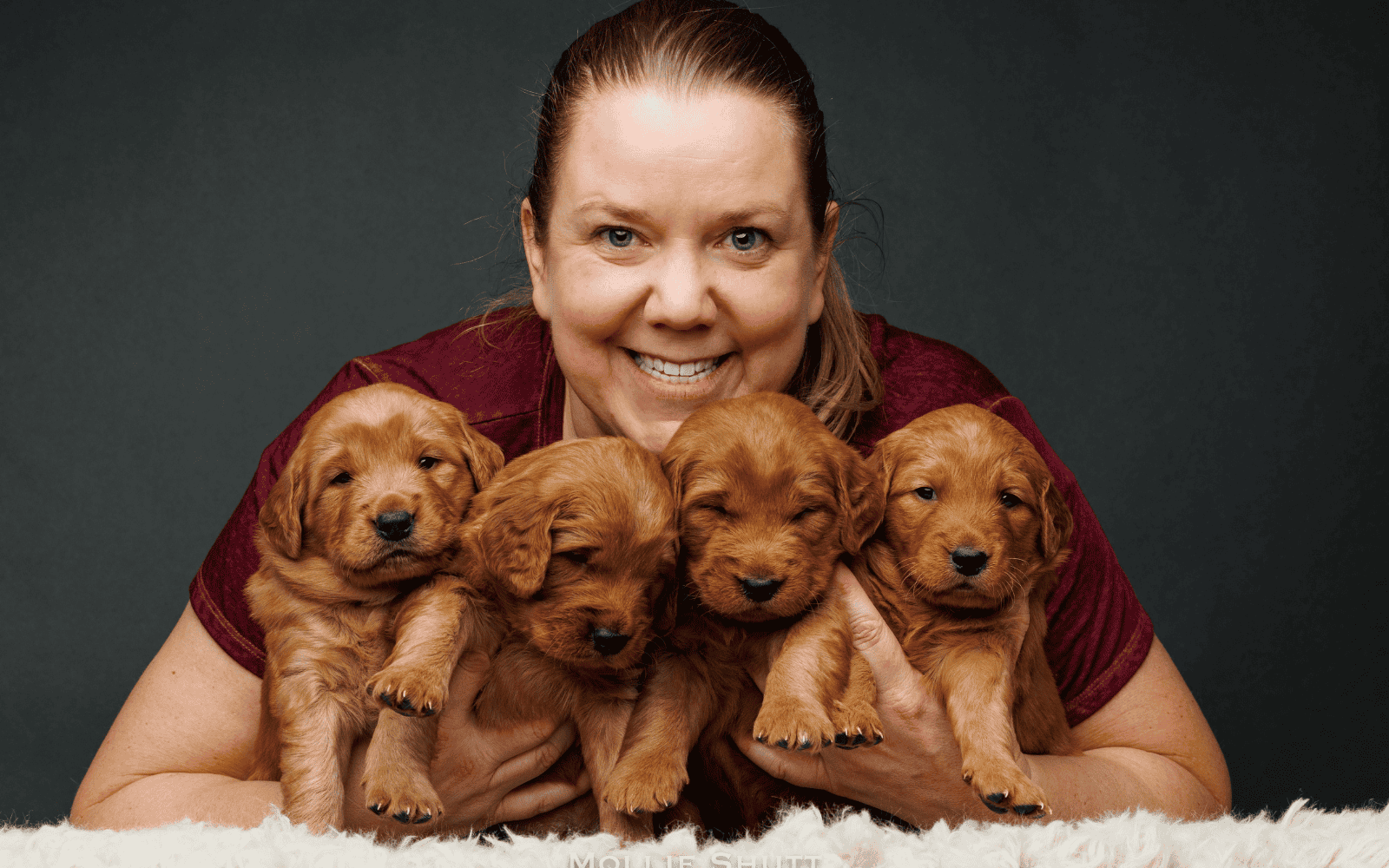
Eventually that led her to Havanese and later Mini Golden Retrievers, which she breeds today.
Trust Before Love
Something became clear during my conversation with Heather.
The lessons from fostering did not disappear when she entered the pet industry.
When I asked what people and animals really need from us in order to feel safe and thrive, Heather’s answer was beautifully simple:
Consistency.
Boundaries.
Love.
In that order.
For Heather, if someone doesn’t know whether you’re going to show up or whether your behaviour is predictable, they can’t properly relax into the relationship.
Safety comes first.
Then trust.
Then connection.
It’s a useful principle when thinking about dogs.
But also clients.
Team members.
Business relationships.
Communities.
If our words and actions constantly contradict each other, people stop trusting us.
Connection isn’t something we can demand.
It has to be built.
Ethical Breeding Is Not a Nine-to-Five Job
One of the other myths Heather and I discussed is the idea that breeding is easy.
Having done a little hobby breeding myself in the past, I know first-hand that it absolutely is not.
Heather had recently spent an entire night awake supporting one of her dogs through labour.
And that is part of the job.
Birth doesn’t schedule itself conveniently into office hours.
Neither do sick puppies.
Welfare concerns.
Emergencies.
Health testing.
Training.
Client questions.
Retired dogs.
The list goes on.
Heather has now built a substantial operation, with her husband, employees and a dedicated training facility.
But bigger doesn’t necessarily mean easier.
Quite the opposite.
More dogs means more systems.
More staff.
More overheads.
More management.
More responsibility.
And Heather is refreshingly open about sometimes looking back towards the simplicity of having only a handful of dogs and thinking:
That sounds quite nice.
Why Heather Started Mentoring Breeders
Heather loves learning.
As her breeding career developed, she became frustrated at how difficult it was to access good information.
There was a lot of gatekeeping.
People holding tightly onto knowledge.
So Heather started creating the education she wished had existed.
Today the BHB Community includes breeder education, free virtual summits, masterclasses, Q&As and ongoing support.
She brings in vets, experienced breeders and other specialists to discuss everything from animal health to marketing, business and wellbeing.
And again, that links back to those early foster-care lessons.
What if we helped instead of judged?
What if somebody doing something imperfectly doesn’t need public humiliation?
What if they need better information?
Support?
Education?
A conversation?
That doesn’t mean lowering ethical standards.
It means helping people reach them.
Diversification Can Protect a Business
Heather and I also talked about multiple income streams.
Her businesses include areas such as:
- dog breeding
- puppy training
- breeder mentoring
- membership and education
- pet nutrition support
- affiliate income
There are clear advantages.
If one stream becomes quieter, something else may provide income.
Clients can also receive more comprehensive support.
But there is another side.
Every offer brings administration.
Delivery.
Marketing.
Systems.
Customer support.
Sometimes team members.
And eventually, diversification can become fragmentation.
When Growth Starts Costing Too Much
Heather is currently at an interesting stage in her business.
She’s simplifying.
An annual breeder retreat, for example, became expensive and enormously time-consuming to organise.
So rather than automatically doing it again because that’s what the business does, Heather is asking better questions.
Is this profitable?
Does it genuinely serve people?
Does it serve me?
Could it be delegated?
Does it need to evolve?
Should I stop doing it altogether?
Those are questions I think many pet-business owners avoid.
Because we become attached to things we’ve created.
Sometimes an offer has served its purpose.
That doesn’t mean it needs to exist forever.
Nobody Is Doing Everything
At one point I jokingly called Heather Superwoman.
She quickly corrected the idea.
Her house, she said, was currently a disaster.
And I loved that honesty.
Because social media creates a strange impression of business owners.
You see the successful breeding programme.
The event.
The team.
The beautiful facility.
The mastermind in Italy.
What you don’t see is the washing pile.
The exhaustion.
The thing they forgot.
The project that isn’t working.
The part of life currently getting less attention.
Nobody is doing everything.
Heather’s point was that there is always something we aren’t getting to.
And perhaps the answer isn’t pushing ourselves harder.
Sometimes it’s acknowledging that we have limits.
Your Zone of Genius
That naturally led us to delegation.
If you can pay someone to do something that drains your time and energy while you focus on work that only you can do, that can be a very sensible investment.
Not because certain tasks are beneath you.
But because time is finite.
This is particularly relevant as a business grows.
Trying to hold onto every role eventually turns the owner into the bottleneck.
And often the exhausted bottleneck.
If You Only Had Ten Years
One of the most thought-provoking parts of our conversation came from a mastermind Heather had recently attended in Italy.
Someone posed a question:
What if you knew you had ten years left?
How would you spend them?
Heather has been thinking about that ever since.
Would you work the same hours?
Keep the same projects?
Chase the same targets?
Spend the same amount of time worrying about what somebody on the internet thinks?
What would matter?
What would you keep?
What would you stop?
What would you finally make room for?
Heather isn’t stepping away from business.
But she is thinking more intentionally about what she wants her next chapter to contain.
Sometimes Business Growth Means Less
We often talk about growth as though it only has one direction.
More clients.
More revenue.
More services.
More staff.
More followers.
More.
But perhaps there’s another form of growth.
Discernment.
Knowing what works.
Knowing what matters.
Knowing what you’re particularly good at.
Knowing when to delegate.
And knowing when something has stopped earning its place in your life.
For Heather, the next chapter seems to be less about adding another ten projects and more about making sure the things she keeps genuinely matter.
And I think that fits beautifully with everything else she learned from foster care.
Connection doesn’t come from doing everything.
Sometimes it comes from being sufficiently present for what’s already in front of us.
Listen to the Full Conversation
🎧 Watch or listen to my full conversation with Heather Gibson on The Pet Business Wellbeing Podcast here
Find Heather
🐾 Big Hearted Breeders Website
🐾 BHB Community & Membership
More Support for Your Pet Business
If some of Heather’s reflections around growth, overwhelm, simplification and building a business that supports your life have resonated, there are several ways I can support you too.
I offer:
One-to-one business mentoring for personalised support around your pet business.
Circle+, my ongoing group mentoring and wellbeing membership.
A growing collection of digital resources to help with the practical and human side of running a pet business.
And my first online course is currently in development too.
You can find out more via The Pet Business Wellbeing Mentor Facebook Page
You’re also very welcome to join my free Facebook group The Pet Business Wellbeing Circle
Wellbeing isn’t a luxury. It’s part of the business plan.
